
Industrial safety engineering · Oxfordshire & UK-wide
Part of Oxford Science Group01865 416840
Person in a branded black shirt facing industrial pipework and equipment.
Survey to handover

Robot Cell Guarding Engineering Process

A controlled route from hazards and access tasks to installed guarding, integrated safety functions and recorded handover evidence.

Representative image; garment branding digitally retouched.

Arrange a site survey

1. Desktop review and site survey.

An initial review can often establish the likely project route from photographs, a layout and a description of the cell. A site survey then captures the machine boundary, robot envelope, tooling, product flow, access tasks, operating modes, stopping behaviour, surrounding walkways and site constraints.

We identify routine operation as well as setting, teach, cleaning, recovery, jam clearance, planned maintenance and foreseeable non-routine intervention.

2. Risk and responsibility review.

The safeguarding concept needs a clear understanding of the hazards and who is responsible for each machine and interface. Robot, tooling, conveyors, process equipment, fixtures, access gates and existing control systems may be supplied by different parties. We define the agreed scope and the information needed from others.

Scope clarity is a safety control. Every gate, opening, stop interface and restart action needs an identified owner so nothing is assumed between suppliers.

3. Safeguarding concept and detailed design.

We develop the physical boundary, safe distances, panel types, access points, interlocks, protective devices, emergency stops, reset stations and control interfaces around the machine and the task. Maintainability, alignment, cleaning, visibility and installation access are considered during design.
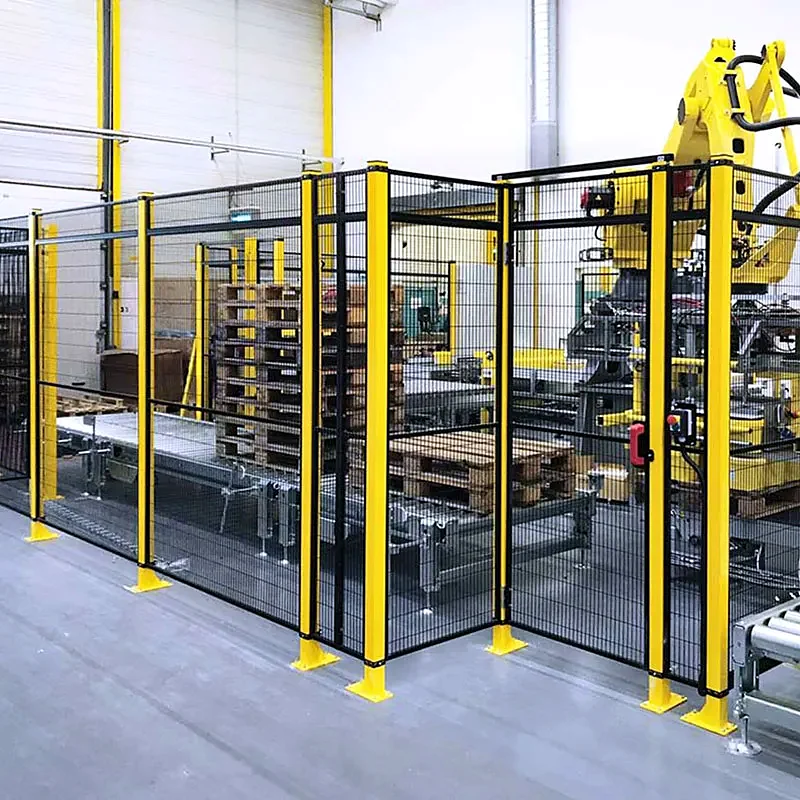
Yellow industrial robot and pallets behind black mesh fencing with yellow posts.

4. Manufacture and preparation.

Panels, posts, doors, infill sections and mounting hardware are manufactured to the agreed design and finish. Purchased safety devices and control components are coordinated with the mechanical assemblies. Installation planning covers access, shutdown windows, lifting, floor fixing and interfaces with other contractors.

5. Installation and integration.

Guarding is installed, aligned and fixed to the approved arrangement. Interlocks, guard locking, scanners, light curtains, emergency stops and reset controls are installed where included. Safety-control changes and robot or machine interfaces are implemented within the agreed responsibility boundary.

6. Commissioning, functional checks and handover.

The installed system is checked against the design intent. Tests can cover gate opening, guard release, protected-field interruption, emergency stop, mode behaviour, fault response, reset, restart and prevention of unexpected movement. The agreed drawings, device information, configuration backups and test records are then handed over.

Direct answers

Technical questions.

General guidance only. The machine-specific assessment controls the final design.

What information is needed for a robot-cell survey?

Useful information includes overall photographs, layouts, robot and tooling details, access tasks, operating modes, stopping behaviour, control drawings, site constraints and the project timescale.

Can the scope include both fencing and safety controls?

Yes. The agreed scope can combine mechanical guarding, access hardware, protective devices and safety-control integration so interfaces and responsibilities remain clear.

What is provided at handover?

The exact handover is agreed in the quotation and can include drawings, device information, configuration backups, functional test records and operating or maintenance information.

Start with the cell and the task

Discuss your robot-cell guarding project.

Send photographs, a layout or a short description. We will help define the right survey and engineering scope.

Link the guarding handover to the accepted robot configuration

A robot-cell guarding handover should identify the configuration that was actually reviewed and tested. The physical fence can remain unchanged while a new tool, product or robot program changes the operating envelope or access needs. Record the relevant robot, tooling, process and control revisions alongside the accepted drawings and test evidence.

Ask the project team to define which future changes require review and who owns that decision. Examples for assessment include a longer gripper, different pallet position, added process equipment or a revised recovery task. The record should distinguish the approved configuration from options discussed during design but never installed or validated. It should also identify where controlled backups and the supporting device information are held.

Use this reference during maintenance and future automation projects so a software or tooling change is not assessed against an obsolete layout. If several suppliers support the cell, provide a clear contact and responsibility boundary for each interface. This makes the handover more useful throughout the equipment's working life. Send the planned product and tool family with your guarding brief, including variants intended after the first installation phase.

Can a robot program change affect an unchanged fence?

Yes. Changes to motion, tooling or process can alter the conditions on which the guarding assessment was based.

What configuration should robot guarding handover records identify?

The installed and accepted robot, tooling, process, drawings and relevant control revisions, with review ownership for subsequent changes.

Start a project