Engineering content review: Oxford Machine Guarding · Updated 25 August 2026. This page provides general guidance and is not a substitute for the project risk assessment.
Why assess the complete robot application?
The robot manufacturer addresses the robot as supplied. Integration adds end-of-arm tooling, payloads, workpieces, fixtures, conveyors, machine tools, process equipment and control interfaces. Welding, cutting, hot surfaces, ejected material, stored energy and dropped loads may become as important as robot movement.
The assessment should cover automatic production, teach, setting, loading, cleaning, jam clearance, fault recovery, planned maintenance and foreseeable non-routine intervention. These tasks often determine where people need access and whether a fixed boundary, monitored gate, guard locking or presence sensing is appropriate.
What information is gathered during a guarding survey?
- Robot model, reach envelope, payload, speed and operating modes.
- Tooling, workpiece, fixtures and associated process hazards.
- Cell layout, floor levels, walkways, vehicle routes and adjacent machinery.
- Who enters or interacts with the cell, for what task and how often.
- Existing fences, openings, doors, interlocks, scanners, light curtains and emergency stops.
- Stopping information, safety-control architecture, reset locations and restart behaviour.
- Maintenance isolation, escape, visibility, access for lifting and future change.
How does the assessment lead to a guarding concept?
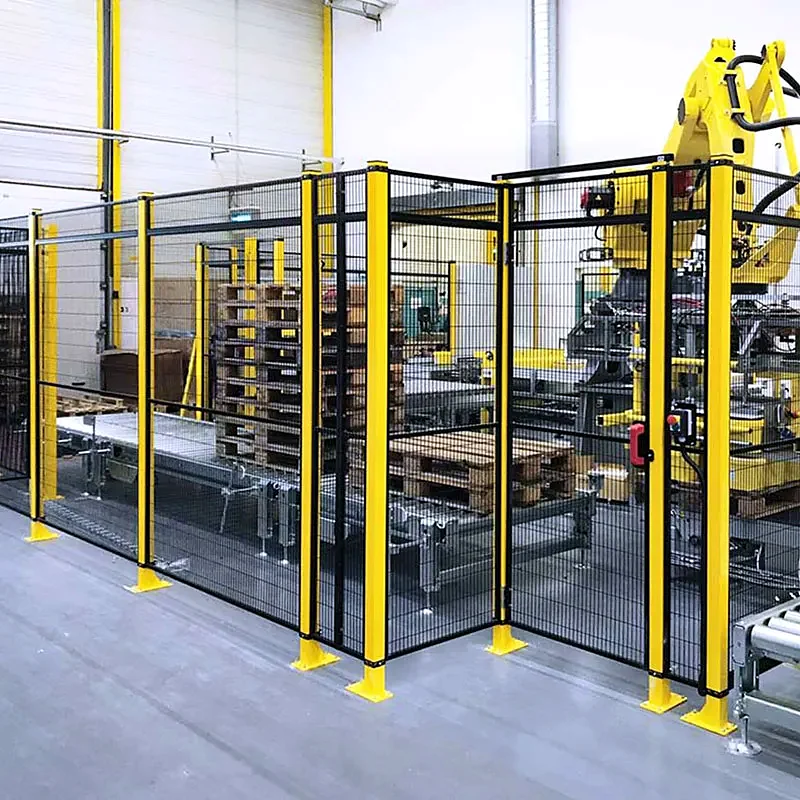
The concept defines the cell boundary, panel type, height, openings, safe distances, gates, access-control behaviour, protective devices and control interfaces. It also records assumptions and responsibility boundaries between the robot integrator, machine supplier, user and guarding contractor.
Safe distance depends on the reach route and the stopping performance of the hazardous movement. A scanner or light curtain may require measured or verified stopping time. A gate may require guard locking if danger remains reachable after an access request.
What should be checked on an existing robot cell?
An existing-cell review looks at the actual use, not only the original drawings. Production changes, new tooling, altered pallets, bypassed interlocks, moved reset buttons, damaged fencing or different maintenance practices can change the risk. PUWER requires work equipment to remain suitable, safe, maintained and accompanied by appropriate protective measures.
Where improvement is required, see robot guarding retrofits and safety upgrades. The scope can range from repairing the physical boundary to redesigning access and safety-control behaviour.
What evidence should a project produce?
The agreed output can include survey records, layouts, safeguarding requirements, device and gate schedules, responsibility matrices, drawings, calculations, safety-function specifications, test records and handover information. The precise documentation depends on whether the project is mechanical guarding only, a safety-system modification or integration of new machinery.
Standards and legal context
PUWER 1998 is relevant to equipment used at work. BS EN ISO 12100 provides risk-assessment and risk-reduction principles. Guard design, interlocking, safe distances and control-system performance draw on further machinery-safety standards. ISO 10218-2:2025 specifically addresses industrial robot applications and robot cells across integration, commissioning, operation and maintenance.
Applicable law, designated standards, conformity assessment and marking responsibilities must be confirmed for the location, machine and project date. Read the robot cell standards and compliance guide.