Engineering content review: Oxford Machine Guarding · Updated 1 September 2026. General guidance only; a machine-specific risk assessment controls the final design.
What normally forms a robot cell safety system?
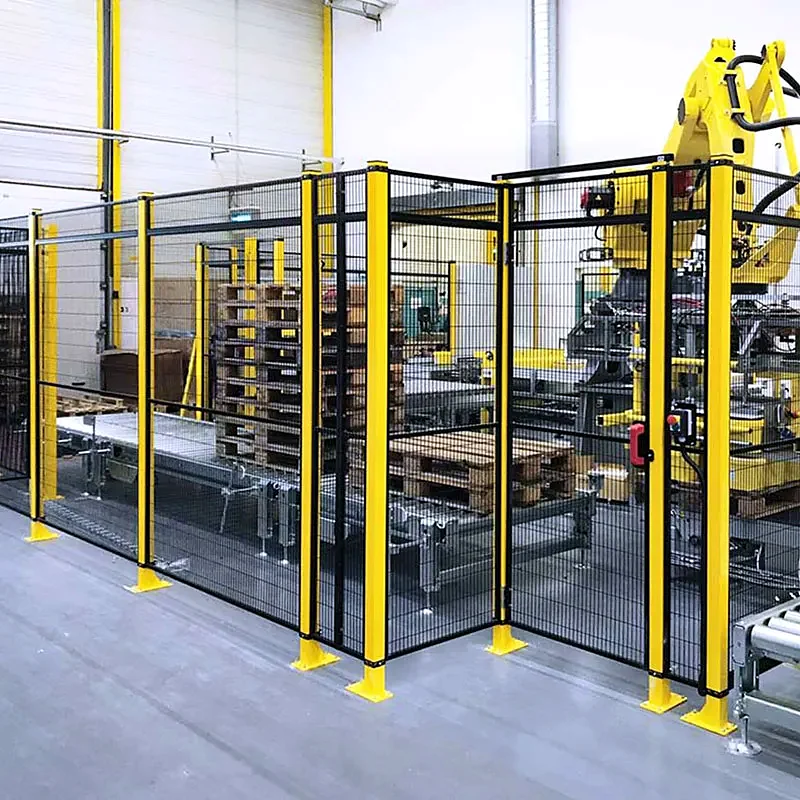
A typical robot cell can combine mesh or solid perimeter guarding, monitored gates, coded interlocks, guard locking, light curtains, safety laser scanners, emergency stops, reset stations and safety-related control functions. These measures must produce a defined response when a person opens a gate, breaks a beam, enters a scanner field or requests access.
The boundary also has to address process hazards. A welding cell can require arc and spatter containment; a machine-tending cell must coordinate the robot and machine tool; a palletising cell needs carefully designed pallet-transfer openings and vehicle routes; and a packaging robot cell must protect product-transfer openings without undermining throughput.
Does every robot cell need fencing?
No single safeguard is correct for every application. Physical fencing is often efficient where people do not need frequent access and hazardous motion can be separated by distance. Presence-sensing devices can support open loading points or access zones when stopping time, approach speed, device coverage and environmental conditions allow. Many systems use both.
A collaborative robot does not remove the need for an application assessment. The end effector, payload, workpiece, speed, force and neighbouring equipment can introduce hazards that require additional safeguards. Read the dedicated cobot guarding and collaborative robot safety guide.
How high should robot safety fencing be?
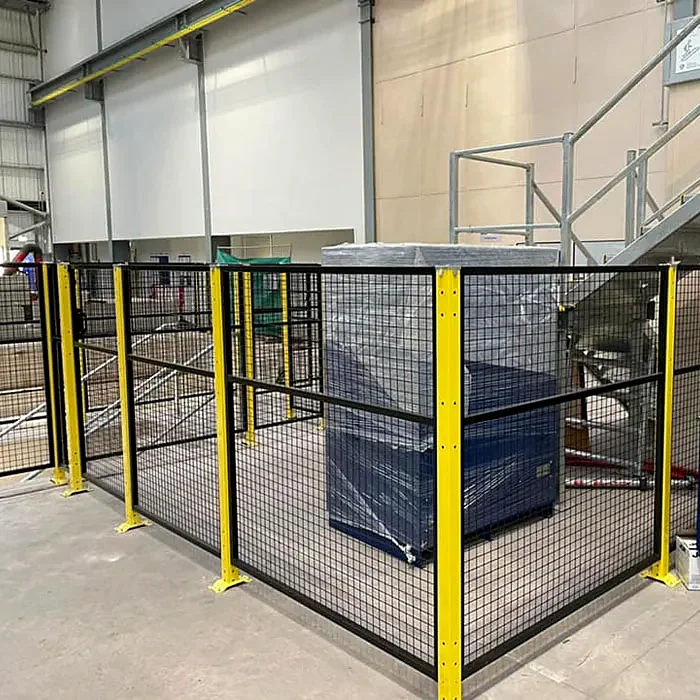
Fence height cannot be selected from a catalogue alone. The design considers the hazard height, reach-over and reach-through routes, mesh aperture, distance from danger, climbing possibilities, floor level changes and foreseeable access. Panel selection and safe distance must be assessed together.
When is guard locking required?
A monitored interlock detects gate position and initiates the specified safety response. Guard locking can be required where hazardous movement does not stop before a person could reach it, where release must wait for a safe condition, or where process containment and controlled access form part of the safety concept. See the guide to robot cell interlocks and guard-locked access.
Can scanners or light curtains replace fencing?
They can be suitable in defined areas, but the design must address stopping performance, approach direction, possible occlusion, crawling or stepping routes, whole-body access, floor condition, contamination, reflections, muting and reset. A protective device only performs correctly as part of a suitable safety function. Read about scanner and light-curtain integration and robot-cell safety distance and stop time.
How is unexpected restart prevented?
Opening a guard or entering a protective field should produce the defined safe state, but stopping alone is not enough. The design also considers reset location, sight lines, trapped persons, presence sensing, fault response and deliberate start logic. Reset should not itself cause hazardous movement. See restart controls and safety integration.
What affects robot cell guarding cost?
The main cost drivers are perimeter length and height, panel material, the number and type of doors, guard locking, protective devices, safety-control interfaces, cable routes, floor conditions, shutdown access, installation, functional testing and documentation. Welding screens, polycarbonate panels, high-speed doors and bespoke transfer openings can also change the scope.
For a useful quotation, provide overall photographs, a layout, robot and tooling details, access tasks, operating modes, stopping information, current control drawings and the project timescale.
What standards and UK duties are commonly considered?
Common references include PUWER 1998, risk-assessment principles in BS EN ISO 12100, guard design in BS EN ISO 14120, interlocking principles in ISO 14119:2024, reach prevention in ISO 13857:2019, safeguard positioning in ISO 13855:2024 and safety-related control-system standards. ISO 10218-2:2025 addresses industrial robot applications and robot cells, including integration, commissioning, operation and maintenance. The applicable British adoptions, designated-standard status and conformity route must be confirmed for the specific project.
Read the fuller robot cell standards and UK compliance overview or start with a robot cell risk assessment and guarding survey.