
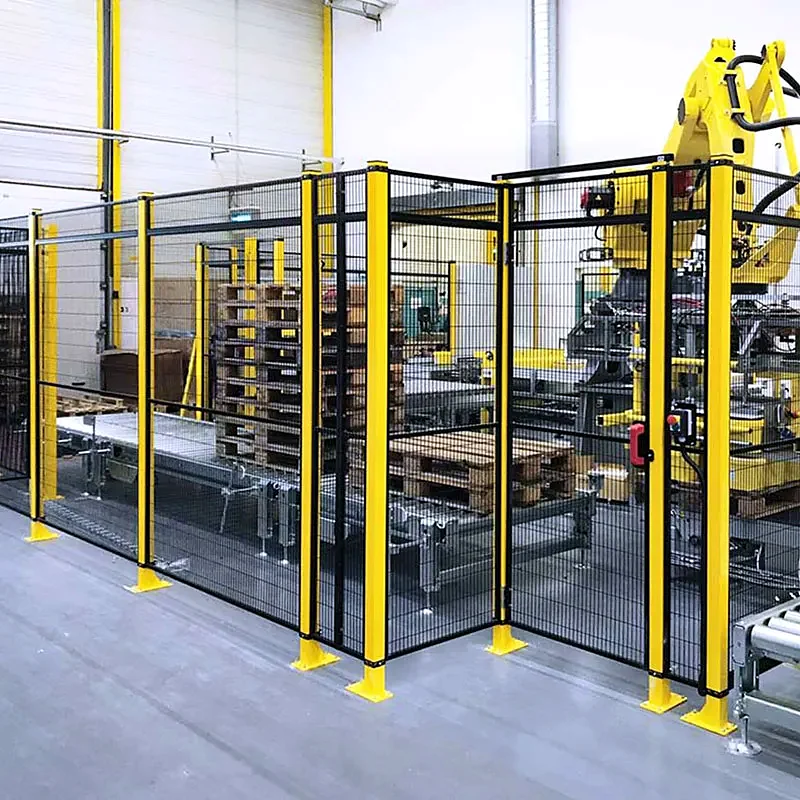
Why pallet transfer is the critical design point
A pallet opening has to pass product while preventing a person reaching hazardous robot movement. The design considers the robot envelope, gripper, load stability, conveyor or pallet position, opening dimensions, approach routes and the behaviour of people and vehicles around the cell.
Options can include reduced openings, tunnels, fixed infill, interlocked doors, light curtains with muting, safety scanners with configured fields or a sequenced transfer arrangement. No one method is automatically suitable for every palletiser.
Personnel access and fault recovery
Operators may need access for slip sheets, fallen cases, pallet alignment, film changes, gripper faults or cleaning. Gates should support these real tasks. Depending on stopping performance, access can use monitored interlocks, guard locking, request-to-enter controls and escape release.
Reset and restart controls need suitable sight lines. Where the complete cell cannot be seen, additional measures may be required to prevent a person being overlooked inside the safeguarded space.
Forklifts, pallet trucks and impact risk
Machine guarding is not automatically vehicle-impact protection. The layout should separate pedestrian, pallet-truck, forklift and AMR routes where practical. Bollards, kerbs or impact barriers may be needed to prevent a vehicle damaging the safety fence, scanner or control station.
Conveyors and associated machinery
The safety response must address all hazards that remain accessible when the cell is entered. That can include conveyors, pallet dispensers, stretch wrappers, turntables and lifts as well as the robot. Responsibility for stop interfaces and restart should be defined across the complete end-of-line system.
What affects palletiser guarding cost?
Cost depends on the perimeter, number of pallet bays, conveyor openings, personnel gates, panel height, interlocks, protective devices, muting or sequencing, control interfaces, vehicle protection, installation and testing. A plan view and product-flow description usually allow a useful first review.
Information to send
Provide pallet size and orientation, case or sack dimensions, cell layout, robot reach, gripper details, conveyor levels, expected throughput, pallet exchange method, vehicle routes, access tasks and photographs of the installation area. We can then define the right survey and design scope.